
A scheme, not a licence
GAMSTOP is a multi-operator self-exclusion service. Its scope and limits are set out in the GAMSTOP terms.
What the phrase means, how UK licensing fits in, and which questions matter before trusting claims about checks, bonuses or withdrawals.
“Not on GamStop” is not a quality standard. This guide separates participation in a self-exclusion scheme from permission to operate, identity verification and the practical protection of your money.
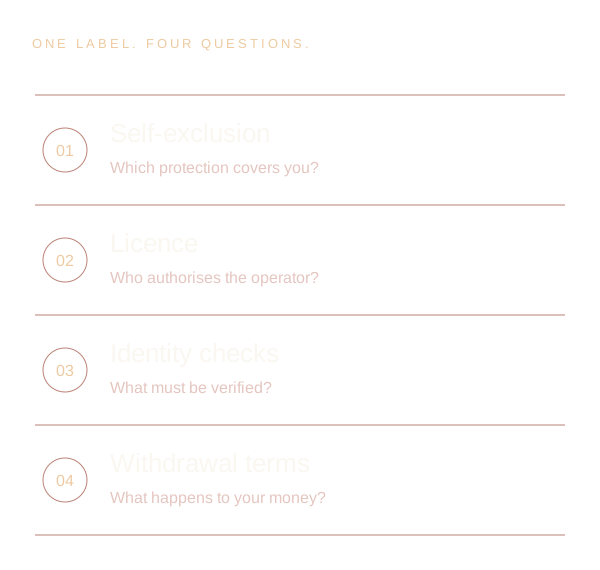
Three distinctions to keep in mind throughout the guide.
GAMSTOP is a multi-operator self-exclusion service. Its scope and limits are set out in the GAMSTOP terms.
Operators serving consumers in Great Britain need the relevant Gambling Commission licence, even when based abroad, as the Commission explains.
Treat payout speeds, no-document claims and bonus headlines as separate promises to examine. None, by itself, establishes that a site offers adequate protection.
The phrase usually describes online casinos presented as being outside the GAMSTOP self-exclusion network. It is a marketing description, not a separate regulatory category, a certificate of safety or evidence that a business may lawfully accept customers in Great Britain. The Gambling Commission has specifically identified “Not on Gamstop” targeting as a feature of the illegal market in its assessment of unlicensed gambling.
Readers can arrive at this topic for different reasons. Some want to understand a term used in an advert. Others are comparing regulation, investigating a blocked withdrawal or trying to make sense of an overseas licence. Those are different questions, and the same headline cannot answer all of them.
The central distinction is between a site’s relationship with a particular exclusion system and the rules governing its business. A logo saying “not on GamStop” does not identify its legal operator. It does not explain which regulator will hear a complaint. It does not establish whether a deposit can be withdrawn, what evidence will be requested or how personal data will be handled.
Replace “Is it on GamStop?” with four separate questions: who operates it, what permission covers the service, which protections apply to me, and what happens if something goes wrong? A missing answer is not a minor detail.
“Non-GamStop”, “non-UK”, “offshore”, “no KYC” and “crypto casino” describe different things. The first concerns a scheme; the second and third can concern location or regulation; the fourth is an identity-check claim; the fifth concerns a payment method or product. Treating these labels as synonyms conceals the details that need checking.
This guide does not provide a list of businesses accepting self-excluded players. It explains the topic without suggesting that an active exclusion is an obstacle to be worked around, or that a different website makes gambling affordable or safe.
GAMSTOP is a free multi-operator self-exclusion service for online gambling. Its terms describe participating operators licensed to provide remote services to people in Great Britain, and explain that it cannot prevent access to organisations that do not participate. Applicable licensed online operators have been required to participate since 31 March 2020, according to the service’s terms of use.
The service is intended to connect an exclusion decision across participating businesses rather than leaving a person to contact every website separately. That does not make it a universal internet filter. It is important to distinguish a limit in coverage from an endorsement of sites outside that coverage.
The current terms list minimum periods of six months, one year and five years, with a five-year auto-renewal option also available. A registration cannot be deactivated during the chosen minimum period, and reaching the end of that period does not automatically end the exclusion. Without auto-renewal, the terms provide for continued exclusion for up to a further seven years unless the deactivation process is completed; see the current GAMSTOP conditions.
Do not rely on an old comparison article to tell you whether a registration is still active. Check your account and the current service terms. Updating information or extending protection is different from cancelling it, and neither a casino advert nor a third-party review can determine your registration status.
GAMSTOP asks registered people to keep personal information up to date so participating businesses can identify them effectively. Its official guidance also recommends additional tools such as blocking software alongside registration.
Think of these tools as different layers. A self-exclusion record, a block on a device and a restriction on a bank account act in different places. They should support the same decision, not be treated as competing products where choosing one makes the others unnecessary.
For remote gambling offered to consumers in Great Britain, the key question is whether the business holds the relevant Gambling Commission operating licence. Being based overseas does not remove that requirement. The Commission’s remote gambling guidance explicitly explains that an overseas business serving consumers in England, Scotland or Wales still needs its licence.
“UK” is often used loosely in casino advertising. Great Britain means England, Scotland and Wales. This page explains the Great Britain licensing framework; it should not be read as a complete account of Northern Ireland law or a legal opinion covering every reader’s location.
An address, company registration or overseas licence may identify part of a business’s structure. That is useful information, but it does not establish permission to serve every country.
The relevant authorisation concerns the service and market. A website accepting a postcode, displaying pounds or using British imagery is not a substitute for checking that authorisation.
The Gambling Commission advises customers to check who owns the gambling website or app and use its public register, including company or website names and regulatory actions. Licensed sites should display their licence information; the Commission explains the checks in its account-opening guide.
A sensible document check compares the legal entity named in the terms, the website being used and the licence record. Do not assume a badge applies to every similarly named brand or every address using the same artwork. A mismatch calls for clarification, not an assumption that the details are close enough.
An overseas licence does not replace the required Gambling Commission licence for a business serving consumers in Great Britain. That is an operator-authorisation issue; this guide does not make a blanket claim that an individual customer commits an offence merely by visiting a website. Avoid articles that compress these separate questions into “completely legal” without explaining the jurisdiction or activity concerned.
Even where another regulator exists, do not assume its safeguards, complaint powers or enforcement arrangements match the British framework. The practical question is not simply whether a regulator is named, but whether it supervises this business, this product and the dispute you might need to raise.
The comparison below is a framework for reading claims, not a ranking of casinos. A business outside the British licensing system may describe its own rules, but those descriptions should not be confused with the protections applicable to a properly licensed British-facing online casino.
| Question | GB-licensed online casino framework | “Not on GamStop” claim |
|---|---|---|
| Market permission | Relevant Gambling Commission authorisation is required. | The phrase provides no evidence of permission to serve Great Britain. |
| Self-exclusion | Applicable online operators participate in GAMSTOP. | May describe absence from the network, not an alternative equivalent protection. |
| Identity | Age and identity must be verified before gambling. | Says nothing about when documents, financial evidence or checks may be required. |
| Complaints | Operator complaints process and access to approved ADR for eligible unresolved disputes. | No basis to assume access to the same system or enforcement. |
| Money and terms | Read the actual account, payment and withdrawal terms. | Marketing alone cannot establish payout speed, caps, fees or recoverability. |
| Game logos | Regulatory status should be checked independently. | Recognisable artwork or provider names do not establish the operator’s status. |
Regulatory details: remote licensing, GAMSTOP participation, identity rules and complaints and ADR.
Neither column promises that every experience will be trouble-free. Licensing is an important foundation, not a guarantee of winnings or instant service. Conversely, a polished interface does not repair missing authorisation or make uncertain complaint rights equivalent to established protection.
Marketing often puts a simple answer on a complicated subject. Use the checker to separate the claim from the evidence you would need. It works entirely in your browser and does not assess, approve or recommend a particular operator.
An overseas licence is not a substitute for the authorisation required to serve consumers in Great Britain. Check the legal operator, website and relevant licence record.
Ask what exactly the promise covers, when it applies and where the exceptions are recorded. “Instant”, for example, might refer to an internal decision rather than receipt of money. “No documents” might describe the initial registration screen rather than the complete life of an account.
A useful answer is specific enough to retain: the named business, relevant terms, time measurement and exclusions. “Usually fast”, “fully secure” or “trusted worldwide” does not answer a question about your payment or complaint rights. If support only repeats an advertising slogan, the underlying question remains unanswered.
GAMSTOP participation and identity verification solve different problems. One concerns a person’s self-exclusion across participating operators. The other concerns establishing who a customer is and, where applicable, checking age, finances or other compliance information. A claim about one cannot be used as proof about the other.
In the British licensed market, age and identity must be verified before gambling. Electronic checks can make that process quick without a document upload, while other cases require evidence. The Commission also says businesses should not wait until withdrawal to request information they could reasonably have sought earlier, although new legal obligations may justify further checks; see its verification guidance.
Documents can be sensitive even when a request is legitimate. Before supplying them, establish the recipient’s identity, use its authenticated secure process and understand the purpose. Do not send passwords, one-time banking codes or remote-access permissions as supposed verification evidence.
If a request is unclear, ask for a written list rather than repeatedly submitting unrelated material. Keep a record of what was requested and when. There is no universal document checklist or guaranteed completion time that this guide can give for an unidentified business.
A withdrawal is better understood as several stages than one number in a comparison table. You request it, the business reviews it, it releases the payment and the receiving system processes it. A headline speed may cover only one stage. A clear policy should explain where its timer starts and ends.
Identify the balance concerned: deposited funds, cash winnings or a bonus-linked balance. Read any relevant account or promotion conditions rather than assuming all balances are treated identically.
Look for a stated review period, possible verification steps and whether weekends or working days change the calculation. An estimate is not the same thing as a binding deadline.
Ask whether “processed” means internally approved or actually sent. A transaction reference and dispatch timestamp can be more useful than a dashboard label.
Check the receiving account and currency. Where a payment is missing, compare the reference, amount and date rather than repeatedly opening duplicate requests.
Inspect minimum withdrawal amounts, transaction caps, daily or monthly limits, currency conversion and fees. If an advert promises rapid payment but a separate term limits how much can be released, the headline does not explain how long it would take to receive the entire balance.
A £2,000 balance subject to a £500 monthly release limit would need at least four monthly allowances to be paid in full, even if each individual payment arrived quickly. “Fast processing” and “fast access to the whole balance” are different claims.
Do not treat a familiar payment logo as proof that a transaction has the same protections in every situation. Ask whether the method supports withdrawals as well as deposits, whether the account must be in the same name and which business will appear in payment records. A logo alone answers none of these questions.
For a crypto-related claim, consider both the casino’s release process and the transfer itself. Ask which asset and network are supported, how fees are allocated and how amounts are converted. A network transaction cannot establish that the gambling operator is authorised, and a proposed crypto payment is not a solution to an active self-exclusion.
Never treat additional gambling as a reliable way to free a delayed withdrawal. If a site asks for a further deposit to release existing money, stop and obtain an explanation in writing before doing anything else. The withdrawal-problem section gives a practical record-keeping approach.
A large welcome offer is not a measure of a casino’s quality, solvency or willingness to resolve disputes. Before interpreting its value, you need the qualifying deposit, wagering basis, contribution rules, maximum stake, expiry and any restrictions on cashing out. Treat absent terms as absent information, not favourable terms.
Consider a purely hypothetical £100 deposit and £100 bonus with a 35-times wagering condition. If the condition applies only to the bonus, the stated turnover is £3,500. If it applies to deposit plus bonus, it is £7,000. These calculations describe a term, not the money you can expect to win or the cost of completing it.
| Term | Question to ask | Why it changes the picture |
|---|---|---|
| Wagering basis | Bonus only, deposit plus bonus, or another defined amount? | The same multiplier can describe very different turnover. |
| Game contribution | Which games count, and at what percentage? | A £1 stake may not reduce the requirement by £1. |
| Maximum stake | Does a limit apply while the bonus is active? | An ordinary-looking stake might breach promotional conditions. |
| Time limit | When does the offer expire? | A short deadline can create pressure to play more often. |
| Cash-out cap | Is there a ceiling on withdrawable promotional winnings? | The visible balance may not describe the amount eligible for release. |
| Cancellation | What happens to cash and bonus balances if you decline or cancel? | The effect should be clear before accepting the offer. |
For another arithmetic example, £100 of stakes at a stated 10% contribution would count as £10 towards a requirement. That is not a recommendation to increase stakes or seek a different game. It shows why an offer cannot be understood from the multiplier alone.
If you would not otherwise gamble, a bonus is not a reason to begin. If a deadline or near-complete progress bar makes it difficult to stop, the practical response is to step back rather than chase completion. No promotion turns uncertain outcomes into dependable income.
A large games lobby can look convincing, but catalogue size is not a substitute for identifying the legal operator. Treat game-provider names, test-house badges and return figures as claims with a scope. Ask what product, version and testing record each statement actually concerns.
A return-to-player figure is not a personal repayment promise. It should not be read as the proportion of a particular deposit that will return during a short session. Nor does a displayed figure answer whether the operator will process a withdrawal or resolve an account dispute.
Separate the game from the account relationship. A statement about a game’s design does not establish the fairness of bonus terms. A statement about software does not establish market permission. A familiar logo does not explain where a customer should complain.
Game rules, game testing, operator licensing and withdrawal terms are four different subjects. Evidence about one should not be stretched into a guarantee about the others.
Before entering personal details, look for the named business, a meaningful privacy notice, contact details and an explanation of data handling. A phrase such as “anonymous play” should not distract from the fact that an account, payment or support conversation may still involve personal information.
Read beyond a security badge. Ask what information is collected, for what purposes, how long it is retained and how a person can raise a privacy concern. If the notice names a different business from the account terms, seek clarification rather than assuming the difference is harmless.
These are general precautions, not certification that a site is safe. The Commission’s illegal-market guidance highlights risks including weak consumer protections, unfair practices and exposure to financial harm.
If you registered with GAMSTOP, searching for a site beyond its reach does not change the reason for that decision. The useful next question is how to strengthen the protection, especially during a period when gambling feels difficult to control. You do not have to wait for a financial crisis to ask for support.
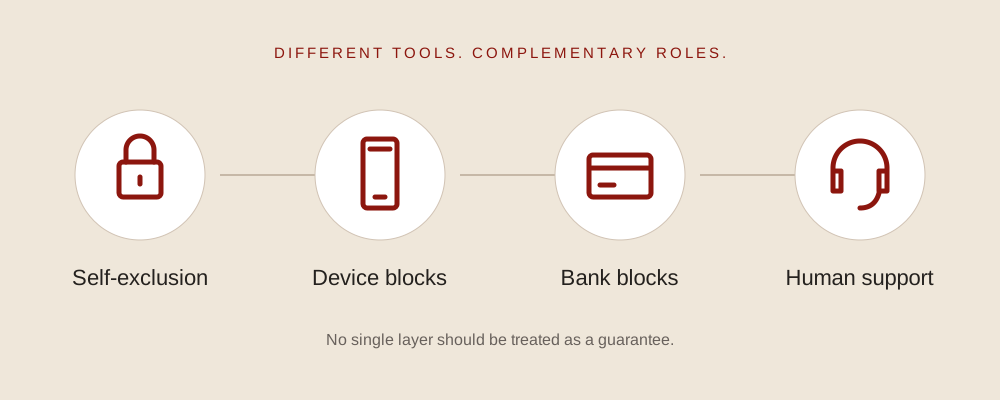
GamCare describes gambling-specific blocking software, bank gambling blocks and self-exclusion as complementary measures. It also offers support with access to blocking tools through its services; see its blocking-software guidance.
Support is also relevant to family members and others affected by someone’s gambling. The National Gambling Helpline is free and open around the clock on 0808 8020 133. Calling does not require having a particular diagnosis, debt level or account problem.
This checklist helps identify gaps in a casino-related claim or an existing account’s paperwork. Completing it does not certify an operator, make an unlicensed service appropriate or override an exclusion. If the basic permission to serve your location is absent, attractive payment terms do not compensate.
Tick only what you have checked against a specific document or official record.
When comparing documents, record when you read them and which domain they applied to. A saved statement from a different brand, a cached advert or another customer’s experience does not establish the terms of your own account.
Start with evidence rather than another deposit. Save the request date, amount, account identifier, payment method, status messages and relevant terms. Keep correspondence in order. Avoid publishing identity documents or complete payment details in a public complaint.
Ask the business to distinguish a compliance review from a payment-processing delay. If documents are needed, request a precise list and explanation. If money has been sent, request the relevant transaction reference. If a term is being relied on, ask for the clause and how it applies.
“I requested withdrawal of [amount] on [date], reference [reference]. Please confirm whether it is awaiting review, approved or sent. If any information is outstanding, specify exactly what is required and why. If the withdrawal is being restricted, identify the applicable term and explain its application. Please also confirm the next response date and your formal complaints procedure.”
Keep the tone factual and preserve the answer. An estimated date can change, but repeated unexplained changes are useful evidence in a complaint. Do not let an unresolved request become a reason to accept another bonus, continue playing the balance or transfer money to an unknown “recovery” service.
For British licensed businesses, the Commission says information should be requested at the earliest reasonable opportunity rather than held back unnecessarily until withdrawal, while recognising relevant legal obligations. It also makes clear that it cannot recover money or resolve individual transactions for customers in its common customer enquiries.
If you suspect fraud, contact your payment provider promptly through its genuine support channel and describe exactly what happened. Ask what options apply to that transaction rather than assuming a reversal is available. Be honest about authorisation and the nature of the payment; a disputed gambling outcome is not automatically an unauthorised transaction.
A complaint route matters before there is a dispute, not just afterwards. Identify the business’s formal procedure, where to send a complaint, what evidence it requires and how the decision can be escalated. A chat button is not necessarily a complete complaints policy.
Within the British licensed framework, operators must have fair and transparent complaint arrangements. The process should take no more than eight weeks, including internal escalation, and eligible unresolved disputes can be referred to an approved alternative dispute resolution provider free of charge. A final deadlock can allow earlier referral, as explained in the Commission’s ADR guidance.
The Gambling Commission is not an ombudsman. Reports may help it identify regulatory concerns, but it cannot settle an individual account dispute or obtain a refund for you. Its customer guidance explains that distinction.
Do not assume the British ADR framework applies to an overseas, unlicensed website. If a different regulator or dispute service is named, establish independently whether the business is covered and whether the issue is eligible. A logo on the casino’s page is not the same as confirmation from the body itself.
A useful complaint is concise: the event, the relevant dates, the amount, the term in dispute, the response already received and the outcome requested. Attach relevant records, not every unrelated message. No dispute process can guarantee that a particular claim will succeed or that money will be recoverable.
One unclear sentence can be a drafting problem. A pattern of missing identities, inconsistent rules and pressure to send more money is more significant. None of the following should be dismissed because a website looks professional or appears high in search results.
When uncertain, pause financial activity, preserve records and use independent support. The absence of a dramatic warning does not certify a business, just as a single positive review cannot establish that its protections will apply to you.
This is an adult information page, separate from the club’s cricket and junior activities. It is not a recommendation to use an unlicensed casino or a suggestion that the club guarantees any gambling business. No operator paid placement, sign-up link or casino ranking is included on this page.
The regulatory and service explanations draw on the Gambling Commission, GAMSTOP and GamCare pages linked beside the relevant information. The document review date is 24 September 2026. Terms and services can change; follow the current official guidance for an individual registration or complaint.
We have not opened casino accounts, deposited money, tested withdrawals or independently audited gambling software for this guide. The numerical examples are deliberately hypothetical and labelled as such. They demonstrate how to read a condition, not how a named operator performs.
This page provides general information, not individual legal or financial advice. If a statement appears inaccurate or a cited service has changed, use the contact page to flag the specific passage. For a gambling account problem, contact the operator or appropriate support body rather than the cricket club.
It normally describes a casino presented as outside the GAMSTOP self-exclusion network. It is not a quality certificate, a separate licence category or proof of permission to serve customers in Great Britain. See the definition and its limits.
The phrase itself establishes no licensing status. Relevant online casinos licensed to serve Great Britain must participate in GAMSTOP. Check the business’s actual authorisation rather than treating a marketing label as regulatory evidence; the licensing section explains how.
No. A business offering covered remote gambling to consumers in Great Britain needs the relevant Gambling Commission licence, even when based overseas. A licence from elsewhere does not replace that requirement. The distinction is explained under market permission.
No. GAMSTOP provides multi-operator self-exclusion. The Gambling Commission licenses and regulates covered gambling in Great Britain. A self-exclusion service, regulator, payment provider and dispute resolver have different roles.
The current minimum-period choices are six months, one year and five years, with a five-year auto-renewal option also available. The exclusion cannot be deactivated during the minimum period and does not automatically stop when that period ends. Check the duration explanation and current official terms.
No. Its coverage concerns participating operators, not every website on the internet. That coverage limit is a reason to consider complementary protective tools, not evidence that websites outside the network are safe or appropriate.
No. This page does not recommend businesses accepting self-excluded players or explain ways to evade an exclusion. Keep the protection in place and see the support and blocking options if gambling feels difficult to control.
No. Scheme participation and identity checks are different subjects. An operator can request verification regardless of how it markets its relationship with GAMSTOP. The verification section explains why no document upload is not the same as no checks.
A later request may arise, including where legal obligations require additional information. In the British licensed market, businesses should not delay requesting information until withdrawal when it could reasonably have been requested earlier. Ask for the specific reason and required evidence; see identity verification.
They need a definition. A claim may describe approval, release or arrival, and those are different stages. Look for the timing basis, exceptions, caps and fees rather than assuming one headline covers the entire process.
A payment method does not establish the operator’s authorisation, complaint rights or reliability. Separate transfer mechanics from the business’s obligation to release funds and the protections applicable to the account.
The headline amount does not explain the wagering basis, qualifying games, maximum stake, expiry or cash-out restrictions. The bonus examples show how the same multiplier can produce different turnover requirements. A bonus is not dependable income.
No. Branding in a games lobby does not identify the operator’s authorisation for a particular market. Check the relevant business record independently and keep game claims separate from account and withdrawal protections.
Preserve the request, amount, terms and messages. Ask whether the payment is awaiting review, approved or sent, and request a precise explanation of any outstanding evidence or restriction. Use the written-request template and formal complaints route rather than depositing more.
No. It is not an ombudsman and cannot resolve individual account disputes or obtain refunds. Reports can inform its regulatory work. The operator’s complaint process and, where eligible, an appropriate ADR provider have separate roles.
For eligible disputes in the British licensed framework, the operator’s process should take no more than eight weeks, with earlier referral possible after a final deadlock. Eligibility and provider coverage matter. Do not assume that framework applies to an unlicensed overseas site.
No individual casinos are ranked or recommended on this page. The guide uses document-based research and hypothetical examples; no deposits, withdrawal tests or software audits were carried out for it.
GamCare’s National Gambling Helpline is free and available 24 hours a day, seven days a week on 0808 8020 133. Support is available for people affected by their own or someone else’s gambling. See the support section.